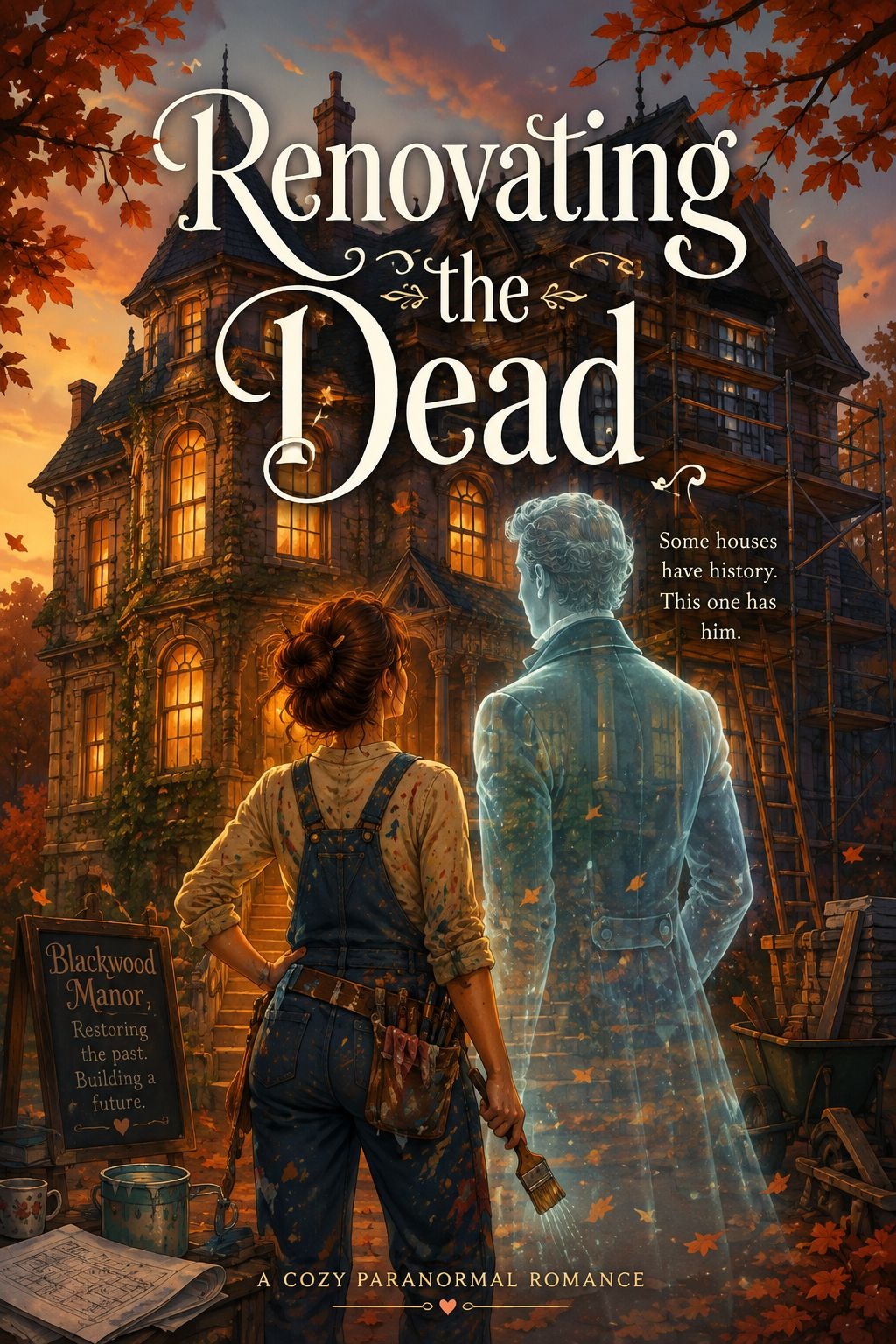
Fiction · Mystery & Thriller
RENOVATING THE DEAD
A Cozy Paranormal Ghost Romance (Blackwood Manor Mysteries Book 1)
by KJ Rose
About This Book
She came to flip a house. He died in it. Neither of them is leaving.
Thea Molyneux's interior design career imploded spectacularly—one viral video, one thrown pillow, and seventeen million views later, she's unemployable, broke, and desperate for a fresh start. Her solution? Buy a crumbling Victorian mansion for pennies on the dollar, renovate it in six months, and rebuild her life from the ground up.
There's just one problem: Blackwood Manor is haunted.
And the ghost has opinions.
Silas Blackwood, acclaimed architect and certified poltergeist, has been dead since 1894. He's spent 131 years protecting his masterwork from people with terrible taste, and he's not about to let some sledgehammer-wielding New Yorker paint over hand-selected mahogany or install what she calls "open-concept flow."
The supernatural war begins immediately. Tools vanish. Paint scrapes itself off walls in the middle of the night. Books fly at her shins. Silas manipulates her smart home devices, sabotages her IKEA furniture, and makes it abundantly clear that he considers minimalist beige a crime against architecture.
But somewhere between arguing about crown molding and emergency roof repairs, enemies become partners.
Thea begins to see the beauty in Victorian craftsmanship. Silas starts to understand modern life. They learn to compromise, to collaborate, to create something neither could build alone. And then—impossibly, inconveniently, completely—they fall in love.
This is paranormal romance like you've never seen it:
A love story that transcends death itself, set in one of the most beautifully haunted houses in New England. Where spirits don't just go bump in the night—they have architectural degrees and strong feelings about subway tile.
But when a greedy developer threatens to demolish the house (and Silas's entire existence along with it), Thea faces an impossible choice: sell the house and save her financial future, or keep it and lose everything except the one person—the one ghost—who makes her feel truly at home.
Perfect for readers who love: grumpy ghost x sunshine renovator · enemies-to-lovers banter · haunted Victorian mansions · fixer-upper charm · cozy stakes, guaranteed happy ending.
Book 1 of the Blackwood Manor Mysteries — each book a complete story, no cliffhangers. Move into Blackwood Manor today. Silas will hate it. That's half the fun.
In a world where paranormal love means choosing between the practical and the impossible, Thea must decide what she's willing to renovate: her house, her career, or her entire understanding of what it means to build a life with someone.
Preview Chapter
T he GPS had died somewhere around the third unmarked turn, which Thea decided was either a sign from the universe or just New England being its usual unhelpful self. She’d switched to the printed directions from the realtor—actual paper, like some kind of pioneer—but the ink had started to blur under her thumb twenty minutes ago when the sky opened up and decided to audition for a disaster movie.
“This is fine,” Thea muttered, squinting through the windshield as the wipers fought a losing battle against the deluge.
“This is totally fine. You’re a professional. You’ve handled worse.”
She had not, in fact, handled worse.
The U-Haul lurched through another pothole deep enough to have its own zip code, and somewhere in the back, her carefully labeled boxes of “Kitchen - Fragile” and “Bathroom - Don’t Judge Me” crashed into each other with a sound like breaking dreams. Thea’s fingers tightened on the steering wheel until her knuckles went white. The road—and she was using that term extremely generously—had narrowed to what was essentially a driveway with delusions of grandeur.
Tree branches scraped against the sides of the truck like fingernails on a chalkboard, and the rain was coming down so hard now that the world beyond the headlights had dissolved into a wall of gray nothing.
And then, through the downpour, she saw it.
Blackwood Manor rose out of the storm like something from a fever dream, all sharp peaks and dark windows and way, way too many architectural opinions. Lightning split the sky behind it, because of course it did, illuminating the three-story Victorian in stark relief: turrets that served no practical purpose, gingerbread trim that looked like it was held together by spite and the prayers of dead carpenters, and enough gables to house a small village of very judgmental bats.
“Oh my God,” Thea breathed.
“It’s worse than the photos.”
The photos had been bad.
The photos had shown a house that was less “charming fixer-upper” and more “probable crime scene.” But the realtor had been desperate—“It’s been on the market for seven years, Miss Molyneux, the price is very motivated”—and Thea had been more desperate, so here she was, staring at what appeared to be the physical manifestation of a Victorian gentleman’s nervous breakdown. She pressed her foot to the gas, aiming for the circular gravel drive that she could barely make out through the rain.
The U-Haul had other ideas.
The front wheels hit the mud—when had gravel become mud?—and suddenly forward momentum became a polite suggestion rather than a physical law. The truck slid sideways, tires spinning uselessly, before settling into the muck with a sound like a giant sucking on a particularly enthusiastic milkshake. Thea sat very still for a moment, listening to the rain hammer against the metal roof.
“Okay,” she said to no one.
“Okay. This is still fine.”
She tried the gas again.
The engine roared.
The truck did not move.
“This is still totally fine!”
She tried reverse.
The wheels whined.
Something in the undercarriage made a grinding sound that suggested it was reconsidering its life choices.
Thea let her forehead drop against the steering wheel.
Through the windshield, Blackwood Manor loomed, dark and unwelcoming and absolutely, definitely laughing at her.
Not a single light showed in any of the windows.
The porch sagged like a disappointed grandparent.
The front door—was that the original from 1887?—looked like it would rather eat her than let her in.
She’d given up her apartment in Brooklyn for this.
Her beautiful, tiny, overpriced studio with the good water pressure and the bodega that knew her oat milk order. She’d burned every bridge in the interior design world with one spectacular, very public meltdown involving a celebrity client, a badly placed credenza, and a viral TikTok that had seventeen million views and counting.
This house was supposed to be her redemption arc.
Her comeback story.
Six months to flip it, sell it to some wealthy couple looking for a weekend escape from Boston, and use the profit to rebuild her reputation somewhere far away where no one had seen the video of her screaming “IT’S CALLED FENG SHUI, BRAD” while throwing throw pillows at a B-list actor’s head. Instead, she was stuck in the mud in a thunderstorm in front of a house that looked like it wanted to file a restraining order against her.
“Get it together, Molyneux,” she told herself.
She grabbed her phone—one bar of service, naturally—and her purse, which contained the keys to the house, her last three hundred dollars in cash, and a family-size bag of peanut M&Ms that she was absolutely not going to stress-eat in one sitting.
She was definitely going to stress-eat them in one sitting.
The rain hit her like a slap the moment she opened the door. Cold, needle-sharp, the kind of October rain that had opinions about your life choices. Thea’s vintage band t-shirt was soaked through before she’d made it three steps, her jeans heavy and clinging, her supposedly waterproof sneakers making obscene squelching sounds with every step. The gravel drive—the parts that were still gravel and not improvised swamp—crunched under her feet as she ran toward the porch.
The steps creaked ominously.
The porch boards creaked even more ominously.
Everything about this house seemed designed to broadcast her arrival to anyone or anything that might be listening. She fumbled with the keys—an actual iron key, heavy and old and unnecessarily Gothic—and shoved it into the lock.
It didn’t turn.
“No. No, no, no—” She jiggled it.
She wiggled it.
She employed the ancient art of Aggressive Persuasion, which mostly involved swearing under her breath and threatening the lock with bodily harm.
The key turned.
The door swung open with a horror-movie creak that would have been funny if Thea wasn’t currently standing in a monsoon contemplating her life choices. The inside of Blackwood Manor was, somehow, darker than the storm. Thea stepped over the threshold and immediately felt the temperature drop. Not gradually—not the normal coolness of a house that hadn’t been heated in years—but suddenly, like walking into a walk-in freezer.
Her breath fogged in front of her face.
She slapped her hand along the wall, searching for a light switch. Her fingers found wallpaper instead—thick, textured, probably original and definitely harboring several generations of dust and possibly asbestos. After what felt like an hour but was probably fifteen seconds, she found the switch and flipped it.
Nothing happened.
“Right,” she said aloud, because talking to herself was the only thing keeping her from completely losing it.
“Because of course the electricity is off. That would have been too easy.”
She pulled out her phone and turned on the flashlight.
The beam cut through the darkness, illuminating a grand entrance hall that looked like it had been decorated by someone who thought “too much” was just a starting point. Dark wood paneling climbed the walls like it was trying to escape to the ceiling. The staircase curved upward in a dramatic sweep, each baluster hand-carved with what looked like twisting vines and possibly screaming faces—it was hard to tell in the phone light.
A chandelier hung from the ceiling, dripping with crystals and cobwebs in equal measure, casting fragmented shadows that danced when the light hit it.
And the wallpaper.
Oh, the wallpaper.
Deep burgundy, patterned with gold medallions and what might have been fleur-de-lis or might have been some kind of Victorian fungus, it covered every surface that wasn’t wood.
It was busy.
It was ornate.
It was the kind of design choice that made Thea’s eye twitch.
“It’s fine,” she whispered.
“It’s all going to be Chantilly Lace in six weeks anyway.”
She walked further into the house, her wet shoes leaving dark prints on the original hardwood. To her left, through an arched doorway, she could see what must have been the parlor—more wood, more wallpaper, furniture shapes hidden under ghostly white sheets. To her right, a hallway stretched toward what she assumed was the kitchen, based on the faint smell of old grease and possibly a raccoon that had died in 1987.
The rain hammered against the windows, and somewhere deep in the house, something creaked.
Old houses did that.
They settled.
They breathed.
They made noises that sounded like footsteps but were actually just century-old beams adjusting to temperature changes.
Thea had read that on a blog.
She was choosing to believe the blog.
She found the kitchen through sheer determination and the process of elimination—it was the room with the ancient cast-iron stove that looked like it could double as a medieval torture device and the deep porcelain sink that was probably worth more than her car.
Her boxes could wait until morning.
The U-Haul could wait until morning.
Everything could wait until morning, when there would be daylight and hopefully less atmospheric dread. She set her purse and keys on the kitchen counter—a scarred butcher block surface that had probably witnessed the preparation of a thousand Sunday roasts—and went to explore the rest of the first floor, just enough to make sure nothing was actively on fire or harboring wildlife.
The beam of her phone flashlight swept across the dining room (table for twelve, naturally, because apparently Victorians never met a dinner party they didn’t want to turn into a theatrical production), the library (floor-to-ceiling shelves, rolling ladder, the faint smell of leather and old paper that would have been romantic if Thea wasn’t exhausted and soaking wet), and a small room that might have been a study or a place where people went to write very depressing poetry.
By the time she made it back to the kitchen, she was shivering. Her clothes were still damp, her hair was plastered to her head, and she was pretty sure she’d just seen a spider the size of a Smart Car in the library.
She’d sleep in the U-Haul.
That was the plan.
She had a sleeping bag in there somewhere, and blankets, and— Her keys weren’t on the counter.
Thea stared at the empty butcher block.
She’d put them right there.
Right there, next to her purse, which was still there, exactly where she’d left it.
“Okay,” she said slowly.
“Okay, I moved them. I definitely moved them and forgot.”
She checked her pockets.
Empty.
She checked her purse.
Wallet, M&Ms, phone charger, no keys.
She swept the phone light across the counter, the floor, the sink.
Nothing.
The cold was getting worse.
She could see her breath now, thick white clouds in the beam of her flashlight.
And then, slowly, she looked up.
The chandelier in the entrance hall was visible through the kitchen doorway, its crystals catching the light from her phone. Sitting on top of the chandelier, balanced perfectly on the decorative finial at its peak, were her keys.
Thea stood very still.
There was a logical explanation.
There had to be a logical explanation.
She was tired.
She was stressed.
She’d probably had a minor psychotic break and sleepwalked into the entrance hall and somehow climbed up there and balanced them on the chandelier without remembering, and that was fine, that was a normal thing that happened to normal people who were having normal mental breakdowns.
The house creaked.
Somewhere upstairs, a door slammed shut.
“I’m going to sleep in the truck,” Thea announced to the empty house.
She walked back out into the rain, didn’t bother locking the door behind her, climbed into the U-Haul’s cab, and wrapped herself in a moving blanket that smelled like cardboard and regret. Through the rain-streaked windshield, Blackwood Manor watched her with dark, unblinking windows.
Thea ate all the M&Ms and told herself she wasn’t crying.
She was just very, very wet.