Fiction · Mystery & Thriller
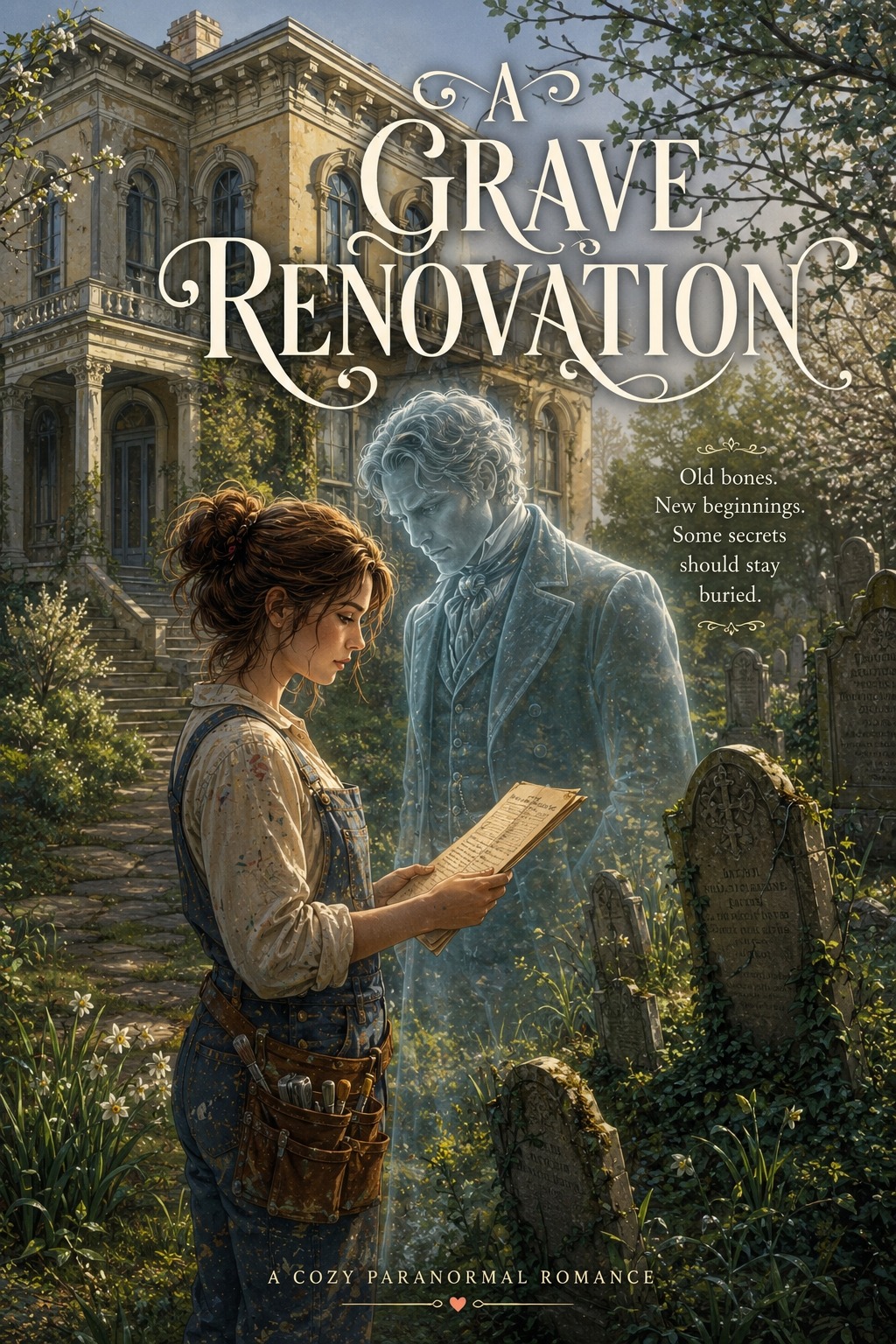
A Grave Renovation
A Cozy Paranormal Ghost Romance (Blackwood Manor Mysteries Book 2)
by KJ Rose
About This Book
A Grave Renovation (Book Two)
Thea Molyneux fixes up haunted houses for a living. She did not expect the next one to come with a body count.
Six months after saving Blackwood Manor — and falling in love with the ghost who haunts it — Thea and Silas have a real business, a working partnership, and an unfinished mystery neither of them can let go. When new client Vivian Hartwell hires Molyneux & Blackwood to restore her family's crumbling Italianate mansion, Thea recognizes a name in the paperwork she's seen before: the Providence Trust, the same bank tangled up in whatever really happened to Silas in 1894.
Vivian isn't telling them everything. Not about the missing family correspondence. Not about why she goes still every time the past comes up. And the deeper Thea digs into Hartwell House's history, the clearer it becomes that its secrets and Silas's death were never separate stories — they're the same one.
As old fraud turns into hard evidence, Thea and Silas edge closer than ever to the truth about how Silas really died — and closer to a man who's spent over a century making sure no one found out. Between renovation deadlines, an increasingly suspicious town, and a romance that keeps threatening to become something neither of them can walk away from, Thea has to decide how far she'll go to get her ghost his answers, even if the truth turns out to be more dangerous than the house.
A Grave Renovation is Book Two in the Blackwood Manor Mysteries — a slow-burn paranormal cozy mystery full of banter, buried secrets, and a love story that refuses to stay in the past. Each book a complete mystery, no cliffhangers. Start with Renovating the Dead, or move right in.
Perfect for readers who love: ghost + human detective duos · haunted mansion renovations · witty banter · gothic secrets with cozy stakes · guaranteed happy ending.
Preview Chapter
Six weeks after Elias Ward called with a name that didn’t exist and a bank draft that did, Thea Molyneux had learned to live with a particular kind of quiet.
It wasn’t a peaceful quiet. It was the quiet of a held breath — of a house where two people had agreed, without quite saying so, not to talk about the thing that mattered most until they had something solid to say. For six weeks she’d woken in the master bedroom at Blackwood Manor — proportioned on the golden ratio because a dead architect had insisted — and her first thought each morning had been a household ledger in a rushed, unfamiliar hand. Paid to Dr. A. Voss, consultation and physic, per Mr. Blackwood’s private instruction. A doctor who had never existed. A payment drawn from a personal account that hadn’t belonged to Silas at all.
Somebody had murdered him. She was fairly sure of that now, the way she was sure of load-bearing walls and water damage — not because anyone had signed a confession, but because everything about the shape of it said so. And the man it had happened to was, she suspected, hovering near the library-study, pretending to read a book he’d read four hundred times, waiting for her to come home so he could pretend he hadn’t been waiting.
So she’d gotten good at not thinking about it. She was, in fact, standing in the front hall of Hartwell House with a clipboard, a tape measure, and the focused calm of a woman practiced at not thinking about the thing she thought about constantly.
“It’s beautiful,” she said, and meant it.
Hartwell House was smaller than Blackwood Manor and considerably less opinionated — a handsome 1880s Italianate with a wraparound porch and none of the turrets Silas insisted made a house look “appropriately serious.” Someone had loved it once, recently enough that the bones of that love still showed: in the deep window casings, in a staircase that curved instead of climbing, in plaster ceiling medallions some long-ago craftsman had run by hand and some more recent owner had painted over in a flat contractor white that made Thea want to weep. It sat two streets off Thornfield Hollow’s Main Street, close enough that she’d walked from the café with a scone in one hand and her tape measure in the other, through cut grass and early woodsmoke and the green hush of a New England town deciding whether it was still summer.
“It was beautiful,” said Vivian Hartwell, in the tone of a woman who had spent thirty years being disappointed by her own house and had run out of patience for it somewhere around year fifteen.
She was seventy-something, silver-haired, dressed with the precision of a woman who had once cared very much what people thought and had decided, late in life, to care selectively. She wore pearls to meet a contractor. Thea respected that enormously. A diamond on her right hand caught the light from the fanlight, and she held herself the way people did when the house around them had been grander than they could keep up with for a long, long time.
“Now it has a roof that leaks into the east parlor,” Vivian went on, “wiring my late husband kept promising to fix, and floors that sound like they’re auditioning for a haunted house every time someone walks across them.”
Thea, who had intimate experience with a floor that genuinely was auditioning for a haunted house, kept her face professionally neutral. “We can fix all of that.”
“Everyone says that.”
Vivian’s eyes moved past Thea, toward the library doorway, with a flicker of something Thea couldn’t quite name. Not distrust exactly. Something closer to dread with better manners.
Thea filed it away. She was good at that now — cataloguing the small tells a house and its owner gave up. A year ago she’d have called it intuition. Now she knew it for what it was: attention, paid patiently, to what a place would rather you didn’t notice.
“I hired you specifically, Miss Molyneux,” Vivian said, “because of what you did with the Blackwood place. Everyone in three counties has an opinion about that house. Most of them are now positive opinions, which I understand is something of a miracle.”
“It took some work.”
“I imagine it did.”
Vivian led her through the front rooms — parlor, dining room, a library with floor-to-ceiling shelving that made Thea’s fingers itch to touch every spine. She kept up a practiced narration, the kind you gave after showing a house to a great many people over a great many years: this cornice was original, that fireplace had been bricked up in the forties and shouldn’t have been, the water stain in the dining room was older than it looked and had stopped growing, she was almost sure.
“The house has been in my family since it was built,” Vivian said. “My great-great-grandfather was one of the founding trustees of the Providence Trust — the bank, not the charitable kind. Made his fortune in textiles and spent the back half of his life making sure everyone knew it.”
Thea’s pen stopped moving.
She looked down at the clipboard so Vivian wouldn’t see her face do whatever it was about to do, and made herself write a word. Cornice. It didn’t matter what word — only that her hand kept moving and her voice stayed level, because six weeks of not-thinking had just collided with the one name at the center of everything she and Silas had been afraid to say out loud.
“The Providence Trust,” she repeated, careful to keep her voice level. “The banking company.”
“You’ve heard of it? I’m surprised. It folded in the twenties, long before either of our times.”
Vivian didn’t seem to notice anything unusual in the question. She was already moving toward the library’s far wall, where a section of built-in shelving looked slightly wrong — a few inches too shallow for the room’s proportions, the woodwork a shade too consistent to be original. Thea had spent the better part of a year learning to read exactly this kind of wrongness. Her eye snagged on the shelf and would not let go.
“I’m renovating a house that had some dealings with them,” Thea said, which was true in the specific, careful way she’d gotten good at being true about Silas without being honest about him. “Historical property research. You know how it is.”
“I do know how it is.”
Something in Vivian’s voice had changed — gone careful, the way people did when a conversation wandered somewhere they hadn’t planned for it to go. She had stopped in front of the too-shallow shelving, one hand resting on the edge of it, the way you’d rest a hand on a door you were making sure stayed shut.
“The Trust’s records are — largely lost, as I understand it,” Vivian said. “Fire, flooding, the usual indignities of history. I wouldn’t put much stock in whatever you’re able to find.”
“That’s a shame.” Thea watched her, and hated herself a little for it, because Vivian Hartwell had done nothing to earn suspicion except own the wrong house and flinch at the wrong word. “I was hoping the family might have kept some personal correspondence. From that era. Sometimes the personal papers survive when the institutional ones don’t.”
Vivian’s hand, resting on the edge of the bookshelf, went very still.
It was a small thing. If Thea hadn’t spent a year learning the vocabulary of small things — a dropped temperature, a held breath, the particular silence of a man deciding whether to tell her the truth — she’d have missed it. But she had, and she watched an elegant woman in pearls go rigid at three ordinary words and understood, with the sinking certainty of someone who has found the soft spot in a beautiful floor, that there was a great deal of rot under this house that had nothing to do with the roof.
“I couldn’t say,” Vivian said, and the words came out a fraction too fast, a fraction too final. “This family has always believed some history is better left where it lies, Miss Molyneux. I hope that won’t be a problem for our working relationship.”
It would, in fact, be an enormous problem, though Thea had no intention of saying so on day one of a job she badly needed. Blackwood Manor did not pay for itself, and a design studio with one completed project and a silent partner nobody could see was in no position to turn down paying clients over a feeling.
She smiled instead, the unbothered professional smile she’d perfected over six years of clients who wanted contradictory things and expected her to want them too.
“Of course not,” she said. “Let’s talk about the roof.”
They talked about the roof.
They talked about the wiring, and the floors, and a bathroom renovation Vivian wanted that made Thea’s teeth itch on Silas’s behalf before she’d even seen it — a soaking tub, a heated towel rack, the wholesale removal of a perfectly good clawfoot that had been in the house since before Vivian’s mother was born. Thea wrote it all down. She’d learned to write things down before she argued about them; it gave the client the sense of having been heard, and gave Thea a day or two to figure out how to talk them out of it.
They walked the second floor, five bedrooms and a sleeping porch badly glassed in during the seventies. They walked the attic, low and hot and full of the archaeology of a family that had never quite thrown anything away — steamer trunks, a dress form, a rocking horse with one ear, boxes labeled in three generations of handwriting. Thea’s eyes went over all of it, cataloguing, and she thought, somewhere in this house there are papers, and somewhere in this house is a woman who would rather burn them than let me read them, and she made herself keep walking.
They walked the wraparound porch that needed re-decking before winter, the boards spongy on the north side where the sun never reached. It was, by every professional measure, a straightforward job for a straightforward client, and Thea took careful notes on all of it.
But she kept circling back to the library. To the section of shelving that didn’t quite match. To a woman who’d gone very still at the words personal correspondence and then talked, very quickly, about roofs.
By the time she got back to the truck — an actual truck now, not the doomed U-Haul she still felt a proprietary fondness for — the light had gone long and gold across the Hartwell lawn, and her hands weren’t quite steady. She noticed that with some irritation. She was a professional. She’d walked into a hundred houses. She had, in the last year, walked willingly into a haunted one and stayed.
But she had never, before six weeks ago, walked into a stranger’s library and found the far end of a century-old crime waiting for her behind the built-in shelving, wearing pearls, asking her not to look.
Her phone was already out. She was texting Silas from the driver’s seat before she’d started the engine.
Providence Trust, she typed. Vivian Hartwell’s family founded it. She got weird when I mentioned personal correspondence surviving.
The reply came fast enough that she suspected he’d been watching the phone, the way he’d taken, lately, to hovering near her devices like a man waiting for a telegram. He’d never admit it. He had opinions about the indignity of a nineteenth-century architect reduced to refreshing a text thread, and he shared them frequently, and did it anyway.
Weird how, he wrote back, and then, before she could answer: Define weird. I require specificity, Thea. You cannot simply say “weird” to a man whose entire existence currently hinges on the word.
She smiled despite herself, despite the low hum of dread that had lived under her ribs since Elias’s call six weeks ago and had never fully gone away. That was the thing about loving Silas Blackwood, alive or dead or whatever precise category he occupied — he could make her laugh across three miles and a century and the entire membrane between the living and the not, and he did it on purpose, and it worked every time.
Weird like she has something to hide, she typed. Weird like maybe we just found the second half of your story.
The reply took longer this time.
Long enough that she’d started the truck, pulled out of the driveway, and was halfway back to Main Street before it buzzed again. Long enough to picture him reading it — the way he went still when something mattered, the way his form thinned at the edges when he forgot to hold it together, the way he’d looked in the library-study six weeks ago when they’d understood that fever had never been the whole truth.
Then I suppose, Silas had written, we had better go find out what it is.
There was no joke after it. No architectural pun, no dry commentary on her driving or her coffee order. Just that — quiet, steady, and underneath it, unmistakable even through a text from a man who’d died a hundred and thirty-one years before smartphones existed, something that felt very much like fear.
Thea drove the rest of the way home with one hand on the wheel and the other holding her phone against her chest, like she could hold onto him through it, and tried not to think about what they might actually find.
She thought about it anyway.
The whole way home.