Fiction · Fantasy
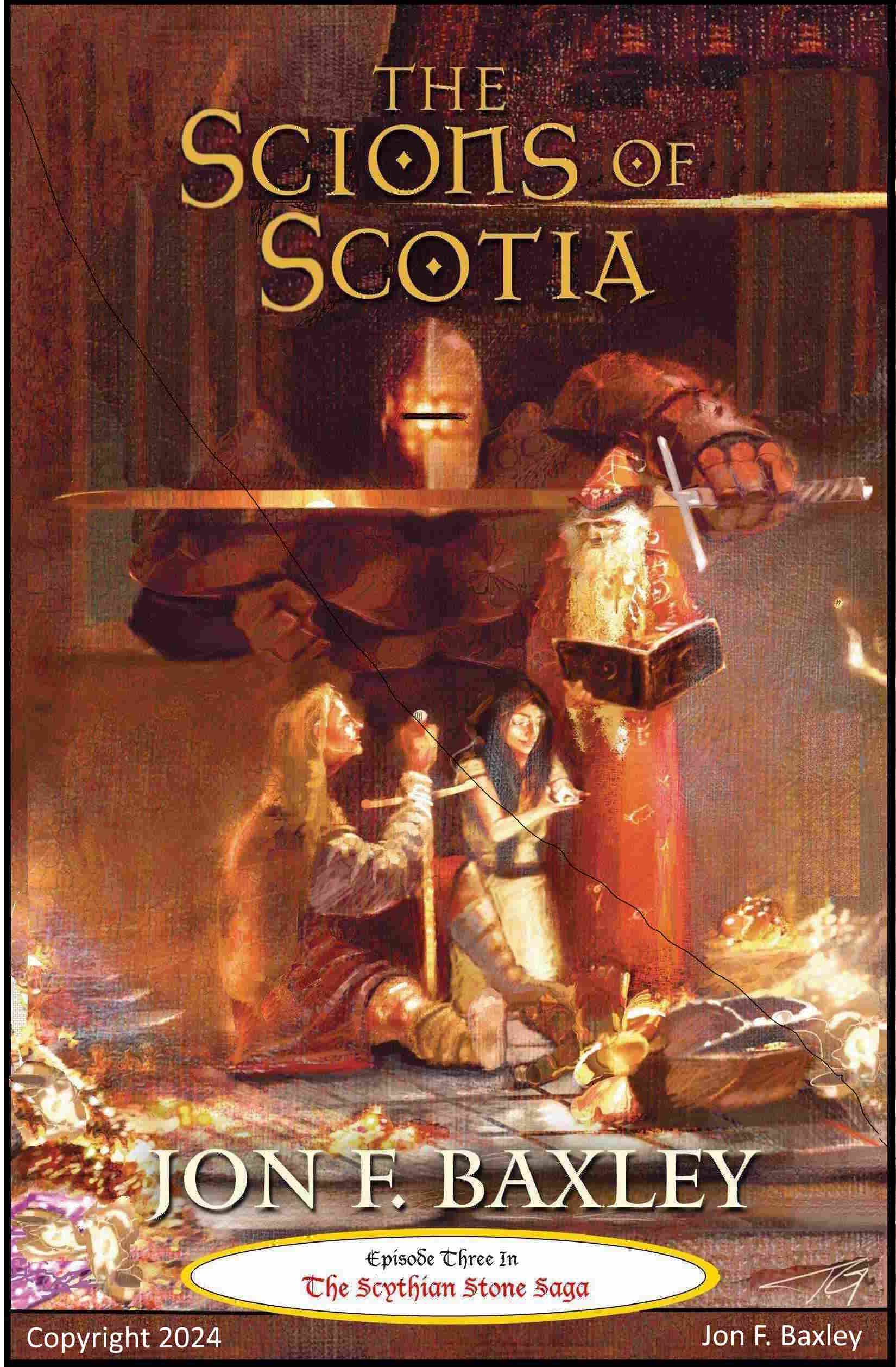
THE SCIONS OF SCOTIA
Book 3 in THE SCYTHIAN STONE SAGA
by Jon Baxley
About This Book
In the dark days before the end of the first millennia, Scotland (or Scotia as some called it) was a leaderless hodgepodge of tribes, clans and warring factions all bent on the same thing--domination of the land. Wizards, sorcerers and magicians still plied their trade, though much of their power had given way to the machinations of men and their war machines. To the south of Scotia lay the realm of the Saxons ruled by Ethelred the Unready and his ruthless minions. To the west, Ireland had just come of age. Everywhere else the constant threat of a lightning swift Viking incursion loomed over the land.
Growing up in this lawless world is a displaced Daynin McKinnon, heir to an ancient familial keep on the island of Rhum. He and his grandfather Ean scratch out a living among the Saxons, careful never to divulge their clan heritage. That all changes when Kruzurk Makshare chooses Daynin as the ideal prospect to help him bring down a vile sorcerer named The Seed of Cerberus, ferreted away in his impregnable fortress at Blackgloom. Little does Kruzurk know that in so doing, he will launch young Daynin, himself and others on a vast, dangerous quest that no one could have foreseen.
*****
One Hollywood producer has dubbed this three book fantasy epic from Jon Baxley as, "BRAVEHEART meets THE LORD OF THE RINGS." Real places, people and events flesh out this fast moving, multi-faceted historical series but fear not fantasy readers. There's more than enough of the magical, mystical mayhem you have come to expect from great fantasy. Romance readers, too, will enjoy the 'spice' in these characters--and there are a lot of them--both human and otherwise.
Join those who have already taken their first steps in THE SCYTHIAN STONE SAGA. Read The Blackgloom Bounty (Book 1) and The Regents of Rhum (Book 2). This series is rated a mild PG-13 for violence and warfare.
Preview Chapter
PROLOGUE
The Island of Rhum, Scotia
Early Summer, 988AD
For the first time in generations, the islands of the Hebrides and the fledgling ‘nation’ of Scotia have crowned a legitimate leader capable of both ruling and forging a union of clans so that the land might finally stand against all enemies—known and unknown. Blood rivalries still simmer amongst the stronger clans and the hill tribes of the mainland, something Daynin McKinnon will be forced to deal with sooner or later. Fortunately, he now has the resources and the beginnings of an army to aid in that effort. Recruits from Scotia, Caledonia, Briton, Ireland and even the mainland of Europe are making their way to Rhum to embrace the banner of what many consider to be the first rightful Scion of Scotia in nearly three hundred years.
Daynin’s enemies still abound. In the south, disaffected clansmen, Celts, Saxons, Caledonians and a host of other n’er-do-wells scheme at the prospect of capturing the vast booty rumored to be held in Kinloch’s cellars. Others from the north and east—Norsemen for the most part—are either bent on conquest or blood revenge for the disastrous defeat suffered on Rhum back in the spring. By far the most immediate threat to Daynin and his new kingdom is the Saxon, Geile Plumat—still held for ransom on the island of Hrossey. Seething with anger and an almost spiritual hatred for Kinloch’s kinsmen, Plumat awaits the return of Thorkell the Tall and Earl deLongait from York, their attempt to secure Plumat’s ransom having taken somewhat longer than anyone expected.
A more ominous threat is Tetula Onuasswano the Skrineyalder, holed up with Dubh the drakon in an ice bound cave on the west coast of Iceland. There, they have both grown stronger. Onuasswano’s madness is fueled by her enraged anger toward the Viking Ivald Skalfholt and his kin who managed to elude and deceive her. She plans to unleash Dubh’s monstrous skills on all who oppose her and in the process, capture the Scythian Stone, making her the most powerful conjurer in the land.
And what of the Kellan, Bjorno Brithnow, sailing home to Scaggerack with what he believes is the real Scythian Stone? Only Captain Ames knows the truth about that. Will he ultimately have to choose between his loyalty to Kruzurk Makshare and a ghastly death at the hands of Scaggerack’s newly appointed leader for having aided in the deception?
Oh, and Isa, the sorceress, carried away in the talons of an enormous sea eagle—has she met her demise or will she return to Rhum somehow and seek the worst kind of retribution on Daynin and Sabritha? Then there’s the giant ghost of Brude McAlpin, or rather his suit of armor inhabited by a ghost and buried under tons of rock in Brithel’s cave—will it be another five hundred years before he rejoins the story?
Chapter 1
Prior Bannock settled himself back at the table, gave Cleric Bargrab of Gairlochy a quick nod in deference to his rank and motioned for his scribes to proceed with penning the testimony. “Let us continue, magician Kruzurk Makshare. How is it that you came to know of things privy exclusively to the Drimnin few—specifically the existence of the Scythian Stone or Scone of Destiny that for half a millennia only the chief loremasters of Drimnin Keep were entrusted to know about?”
The aging magician pulled his red cloak tighter, realizing the implication of that question and knowing what had to come next. He shivered from the damp, cold environs of Kinloch Keep’s lower cellar where the requested ‘interrogation’ had been moved for the sake of absolute privacy. The seal blubber candles the monks had brought down with them wavered and crackled in the dank air sending rancid black plumes of smoke wafting up to a very low beamed ceiling.
Kruzurk’s gaze fell on Bargrab, the only friendly face in the dungeon-like room. “I believe, Prior Bannock, that these questions are becoming a bit rhetorical, are they not? You have the accounts of Bargrab and Perazelzeus, wherein my statement is backed up that any fore-knowledge of the stone before arriving at Drimnin was purely anecdotal. It is common knowledge even among the non-literate in Scotia that the Scythian Stone was and is the sacred stone upon which every king of Scotia, or Dalriada or whatever this kingdom has been called—all the way back to before Roman times—was, in fact, sanctioned and crowned by historical use and precedence. I merely used the stone’s oft-repeated reputation—and a replica of the stone as I imagined it to be—as a ploy to bring down a vile sorcerer. This was asked of me by my mentor, Merlin of Pendragon.”
“Yes, so you have claimed. The same Merlin who has been dead these past eighty years but I’ll let that pass for the moment. Then you admit freely that your use of the stone was a ruse and not some great magic trick. Good. I’m glad we have that part settled. However, my main concern and that of the brethren at Drimnin is that you were somehow able to gain knowledge of the real stone’s whereabouts. To do that, you had to either beguile Perazelzeus, threaten his life or bribe him into telling you where the stone lay hidden. Which was it?”
Kruzurk slammed one hand down on the arm of his chair—a gesture as close to showing anger as he would allow himself. “I’ll stay my tongue a bit here, Prior, in reverence to your order. But know you this. I do not threaten, beguile or seduce. It is not my way, nor is it a practice of the Magician’s Guild to which I am sworn for life. Your chief loremaster not only instructed me where to find the stone, he also provided the means and directed me to retrieve it. The orb on the tip of my staff—that was offered freely by Perazelzeus to aid in the finding. Likewise, the whereabouts of the stone was offered to me with only one request—that I should retrieve it and take it to Rhum as fast as possible. Even then, I doubt Zeus knew for certain that the stone actually rested where he said it would be. After all, the Scythian Stone had not been seen by anyone in some ten generations.”
Bannock abruptly shifted his focus. “You hesitate or outright avoid discussing your so-called Guild ‘skills’ when I mention the use of what I can only assume is magical power or charms of making. At least, that is what witnesses have told us thus far in their sworn statements. Are you also able to employ black powers—sorcery, even—to accomplish your objectives?”
Kruzurk sipped from his dram of warm beer, eyeing the trio of robbed interrogators, knowing that every word was being transcribed for the full Drimnin brotherhood to read later. “Sorcery? No, never. Absolutely not! I am sworn to use my powers for good only.”
“And yet, you were somehow able to penetrate a heavily guarded demon’s keep, overcome its garrison and kill the keep’s master. In the process, you were able to capture the vast Blackgloom bounty—an immense treasure ferreted away there, which in turn allegedly financed this Scotian adventure to crown a new regent on Rhum. All without using sorcery, eh? Seems, well, it seems a bit too tall of a tale for me to believe. Perhaps you would care to explain?”
Kruzurk caught a look of exasperation on Bargrab’s face. A quick nod from Perazelzeus’ chosen representative told the magician to go ahead and relay what he knew, sparing nothing. “Your grace, you must understand that every member of the Guild harbors a fear that the use of our powers might in some way adversely affect the world we live in. Thus, we disdain sorcery in any form and are only inclined to use magic when no other means-to-an-end is possible. Members of the Magician’s Guild prefer to leave the world to its own devices—its own outcomes—insofar as is possible.”
"Oh, really?” Bannock chirped, rank skepticism for Kruzurk’s ilk quite clear in the man’s voice. “Yet, I’m told you’ve consorted hereabouts with dead giants, pig-like beings, invisible creatures—even sea monsters—to crown a boy king who, from my perspective, has only a very tenuous birthright connecting him to the crown. Do you still insist that none of this was of your making—that you did not use your powers to bring all this about for your own motives?”
Avoiding the question, Kruzurk said, “Think of it this way, your grace. Suppose my innate magical powers are represented by clear water sitting brim full in a wagon wheel sized bowl on this table. On the left of the bowl is a pile of small white stones. To the right is an equally large pile of black stones, each of them being the size of ten white ones.”
“Innate powers? I thought you were taught by Merlin,” the second inquisitor interrupted.
Slightly miffed by the implication, Kruzurk answered, “Yes, Prior Trane, Merlin was my mentor at a very early age. Unfortunately, he passed to the other side before I had reached the age of decision. Otherwise, I might have been enlisted to take his place as Grand Mentor at some point. You see, Merlin had the unique ability to recognize prodigies born with the gift of magic. When possible, he would take aside those willing to develop the art as he knew it and raise them in the ancient traditions of the Magician’s Guild. In the old days, these prodigies would have been called Staff Apprentices, for they learned the magic of the staff from the roots of the art all the way up to its rightful, proper and controlled usage.”
“And those that went awry? What were they called?” Trane asked, his hand busily scratching notes on parchment without ever looking up.
“There is a term for that, but I am not at liberty to divulge it outside the Guild. Most people simply refer to magic users who slip over to the dark arts as sorcerers. Interestingly enough, many of those are women. A standing concern in the Magician’s Guild is that women make wonderful magicians as long as they are fully trained before their child-bearing years. After that, the Guild nor anyone else can control a sorceress’ surging need to procreate—to bring forth beings—monsters if you will—or to take magic to realms it was never intended to be used.”
“Hmm,” Prior Bannock said, “that must be why the land has more witches than warlocks.”
“Indeed,” Kruzurk replied. “Typically, witches are sorcerers who have never born children. That is why they have such an evil bent toward younger beings, be they human or otherwise.”
“This bowl you were describing . . .” Trane pressed.
“Ah yes. A fully trained magician begins life with a large supply of good intent—the water in the bowl if you will. The white stones represent the good things he or she can provide the world through the use of magic. Curing a child of a deadly disease, for instance. Or helping an unjustly convicted felon find proof of his innocence. For each of these deeds, imagine one small white stone being placed in the bowl—the brim full bowl. What happens? A bit of the water flows out around the rim and is lost forever—irreplaceable, just like our days of life. Once used, never to be seen again.”
The third interrogator shifted uneasily, keenly aware of what had to come next. “And the black deeds?”
“Precisely, scribe Shard,” Kruzurk said. “The black stones—well—you can imagine. Those are evil deeds any magician can perform, but they are costly—very costly. That’s why the black stones are ten times the size of the white ones and thus remove ten times the amount of water when placed in this imaginary bowl. Have you ever heard anyone speak of an old sorcerer? No, likely you have not. You see, the water in the bowl also represents the magician’s lifespan.”
“So, a black deed shortens a sorcerer’s life?” Bannock asked.
Kruzurk sipped another drink. “Yes. A black deed displaces ten times the lifespan of a good deed. There being no way to replenish the water in the bowl, that means sorcerers’ lives are wagered against every deed—good or bad—that they perform. It does not take a Pythagorean mind to see the end result.”
The main interrogator took a long draw on his mug, eyes searching Kruzurk’s deeply scarred face for any sign of deceit. “Then you all—magicians, sorcerers, witches, whatever—you all have finite existence?”
“Of course. As is God’s plan for every mortal. Yes, we can use magic to prevent our death or someone else’s—much like a warrior uses his shield to deflect enemy arrows. We can also hasten the death of another, though that is seldom done. In the end, it is the Almighty who makes that choice. You will also note that any action that has the potential to bring about another’s death—such a deed will likely fill half the user’s ‘bowl’ with several black stones at one fell swoop—possibly enough to kill the spell caster on the spot.”
Trane cleared his throat. “So, Kruzurk Makshare, you admit that you have to think about each and every deed you perform, whether good, bad or otherwise? It is an act of volition? A cognitive act?”
“Oh, absolutely your grace! I’ve never denied that. For example, I have to be careful not to ‘wish’ for a friend’s windfall of gold, or property or even health. Doing so costs me—instantly and wishing something does not guarantee that it will come to pass.”
Prior Bannock’s head drew back sharply. “What do you mean? You cast a spell, or, or, wish for something and it doesn’t happen?”
“Unfortunately, yes. A half wished spell or one not properly thought out in the mind beforehand may well go completely awry. Spells cast in haste or when distracted often go unfulfilled or worse—fail miserably or even backfire. Sadly, they still count in the great bowl of life we magicians carry with us constantly.”
“Again you admit freely,” Trane went on, “that using your so-called powers can cause harm as well as good?”
Before Kruzurk could answer, the smallish third inquisitor, Shard, interrupted. “Don’t answer that. I must remind my cohorts that this is not a court of law but of inquiry. We are here to clarify, not judge. We are here to discern how it is that Kruzurk Makshare had knowledge of certain events thought to be held in profound secrecy by our Order at Drimnin. What he does with his innate abilities is like asking a priest to divulge his personal connection to the Almighty and I object to that vehemently.”
Prior Bannock nodded, agreeing to that pronouncement. “So be it. Trane, you will put aside your bias and merely record this inquiry. We will take the results back to Drimnin for further study. Now, Kruzurk Makshare—please continue and know that what you say here will only be divulged in cloistered discussions—not for outside scrutiny—understood?”