Non-Fiction · Self-Help & Personal Growth
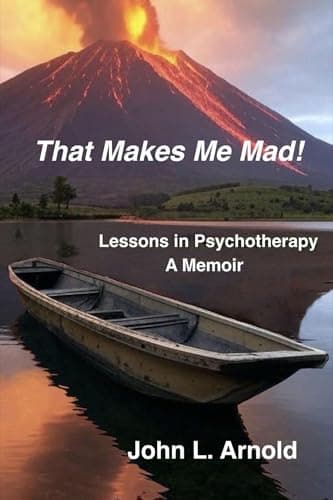
That Makes Me Mad!
Lessons in Psychotherapy - A Memoir
by John Arnold
About This Book
Described in review:
I found "That Makes Me Mad!" to be very approachable and indeed gave me new tools to understand, accept responsibility for, and adjust my attitude to my own angers. Best $10.00 session I ever got.…
Available Formats
Paperback
Hardcover
eBook
Preview Chapter
Chapter may be trimmed to fit.
Preface
Apart from presenting some other psychotherapy practice ideas that were helpful to me and my clients, this book is about a cultural discrepancy between what most people believe regarding how emotional feelings are generated and how we actually act in our daily lives. In brief, most reasonable people believe they are responsible for their emotions and behavior — taking responsibility for one’s feelings and actions is generally accepted as a pro-social no-brainer. …. and often our behavior, to someone or some thing other than ourselves. To wit, in our common vernacular we hear ubiquitous refrains like “That makes me mad.”, “He pisses me off.”, or “She drives me crazy.” These types of commonly heard phrases inherently infer that the creation of our feelings is caused by other people or events. The premise of my suggestion is that these comments are not simply a figure of speech or an irrelevant issue of semantics. Indeed, they are embedded not only in our language but in our cultural psyche and subsequent behavior as a result of this largely unexamined discrepancy. More importantly, I’m suggesting that this discrepancy facilitates not only a widespread, lessened understanding of emotional control but is an obstacle to our attempts at self-actualization, increasing self esteem, and promoting contentment.
The argument can be somewhat provocative. Although I haven’t yet presented anything here that is likely to provoke dissonance, when someone says “Actually, other people don’t make you feel, you make yourself feel” it can conjure up confusion and pushback. Don’t ask me how I know. This is not an opinion. I’m merely reporting… and would prefer that the messenger not be killed. The fact is: we make ourselves feel because of things that have to do with us, because of our own baggage.
The purpose of this book is to share what I hope is information that can be helpful to others, especially those that are ambushed by anger and irritability, which includes “normal” folk and clinicians alike.
What’s weird about the premise is that I didn’t make it up. It’s not new. It’s all been said before. It’s already been written in literature and from great thinkers, spiritual leaders, and social scientists, none of which I am. If there’s anything profound about it, it’s that the discrepancy doesn’t seem to have been specifically examined in our culture, including the mental health profession.
For instance, in recent years much has been written about anger and much of that discussion continues to use the phraseology that suggests the locus of control of emotions resides outside of ourselves and, hence, seemingly outside of our control. The fact is that each of us is the regulator of our emotions. Initially something untoward or unexpected happens and we react. The nature and degree of our reaction comes from within us, not without. But even writers that do recognize that the mechanisms of emotional control come from within, and can be altered, will nonetheless use language inconsistent with that recognition, eg., “When something happens that makes a person angry….”. I suggest that part of the reason for this, again, has to do with what’s embedded in popular parlance, and what isn’t. It’s the same reason that “I-messages” are challenging to master because we don’t have a familiar language to do so. Plus we’re certainly not practiced at saying things like “I irritated myself with that.” And even if we do, it sounds funny and others think you’re strange. It’s as if we have no common language for taking responsibility for our feelings.
I should note that these ideas have not resulted in my own immunity from the evolutionary holdovers of the primitive parts of our brains that facilitated the survival of Homo Sapiens (to be explained later in this book). But I will say that my amygdala (that part of the brain that has in part to do with emotional control) has, since my childhood, been significantly “tamed”. (See Catherine Pittman, PhD.) I now am happier and have less health-impairing angst coursing through my body. As Lynn Johnson, PhD wrote “this is an achievable goal.” It also represents a concept that I believe can be a faster, simpler path to goals for clinicians and their clients as well as people generally.
I am encouraged, too, by discovering that my hope for the utility of the implications regarding the book’s premise and the Anger-Loss model herein is supported by recent research describing a broader, more “constructionist” view of emotion creation (See the work of Kristen A Lindquist and/or Lisa Feldman Barrett). In her widely acclaimed book How Emotions Are Made, Barrett says of emotions “They are not triggered; you create them.”
*******
Useful books written by psychotherapists can have dumb titles. I once had this thought that psychiatrists shouldn’t title their own books. Although I’m not a psychiatrist I’m guessing the same could apply to me… but I titled it anyway.
I also had a theory about how good therapists came to write books. It went like this: A therapist does therapy and is pretty effective. Friends and others said “You should write a book.” Presumably in an effort to be helpful to others, the therapist did. But effective therapy doesn’t actually have much to do with technique, often the primary explication in their books. But according to research, only about 15% of what is effective in therapy has to do with technique. (See Scott Miller, PhD, et. al., The Psychotherapy Networker, “No More [Bells or Whistles]”).
What tends to get left out of the effective therapist’s book is the unique Self and personality that was actually key to making any technique work. Yet these personal characteristics are rather difficult to self-describe. And I won’t pretend to describe mine. I will say that genuine empathy, non-judgmental acceptance, and an understanding that similarities between therapist and client compared to any differences, are crucial to establishing an effective therapeutic relationship.
Regardless, my desire to write this book has to do with my confusion about why the previously described discrepancy doesn’t seem to be specifically articulated in the literature of mental health practice. Of course therapists are a part of the culture, not apart from it. For example, we were hardly in th e forefront of the women’s liberation movement. We were actually more likely to come up with diagnoses of hysteria for women that were traumatized in abusive relationships.
Be that as it may, my hope and purpose for this book is as stated above despite that I don’t pretend to be a scholar or academic. I haven’t even thought that I had the self-discipline or skills to write a book. And I’m certainly not doing it for fame and fortune. In fact, whether this even gets published, I will be satisfied if I simply get a manuscript done before I shed the mortal coil.
*******
When I was in graduate Social Work school and learning about different theories of personality development, psychological paradigms, and the multitude of techniques that arose from them, I wondered when my coursework would cover some kind of synthesis of these — some metatheory or the “One Ring to rule them all”. My ignorance and naïveté waned eventually but nonetheless I realized that there was some unspoken suggestion that as a would-be therapist, I was expected to choose among these, and which was going to be the foundation of my own practice.
Much later, after the slow realization that my own unique Self was the primary tool around which my practice would evolve, I stopped looking for the Mother of All Therapies.
After I had been given the responsibility and privilege of being a clinical supervisor, I found myself being asked by a form that I had to fill out for a state licensing board on behalf of a supervisee: “What theory base or therapy does the supervisee use in their practice?”Uh-oh. In addition to the use of their own unique Self, I realized the person I was supervising likely was using whatever I was using, but I didn’t know what that was in words because I had never been required to articulate it. So I wrote “Strength-based* approach within a bio-psychosocial perspective. Theory base borrows from CBT and social learning models. Techniques are evidence based and influenced by problem-solving/solution-focused, skill building, and trauma-informed approaches.” Despite trying to be honest and accurate, it was a listing devoid of practice wisdom.
“Practice wisdom”? During my first several years at a psychiatric day treatment center for children, I read that, on average, the most substantive work that a client achieved in therapy occurred during the first 8 to 10 sessions. As the agency’s family therapist, that statistic seemed to ring true. With the thought of trying to maximize those first sessions I had the idea that if I attended a Brief Therapy workshop I might be able to more quickly be effective. I happened to attend a workshop with Lynn Johnson, PhD., a noted Brief Therapy and Positive Psychology practitioner out of Salt Lake City. It was a seminal move on my part. I not only learned that brief therapy didn’t have to do with brevity, but was informed that the business of doing therapy took a lot of practice. Lynn suggested that it took about 8 to 10 years before you might feel like you were “turning a corner“ and actually might be on the threshold of knowing something useful. Coincidentally, including and prior to graduate school, I had been doing work for about eight years and was just beginning to feel a little less like a fraud when I was with my clients.
If I could make people feel, I would make them feel happy. I hope you find this little book useful.
—John L. Arnold, 2024